How to Choose Freezer Bags, Containers and Wraps to Stop Freezer Burn
As an Amazon Associate we earn from qualifying purchases. This page contains affiliate links — if you buy through them, we earn a small commission at no extra cost to you.
Freezer packaging needs to solve three problems: keep air off the food, keep moisture in, and survive stacking or sharp edges. These competing demands explain why bags, containers and wraps aren’t interchangeable equivalents but trade-offs. Understanding which tool solves which problem helps you match your packaging choice to what you’re actually freezing.
Freezer burn occurs when cold, dry air makes direct contact with the surface of your food over time. The mechanism involves water molecules migrating outward, sublimating through the air trapped between your food and its packaging, slowly dehydrating the outer layer. The ice crystals that form cause cell walls to fracture, which is why thawed burnt patches feel grainy and taste flat.
The critical detail is the word trapped. It’s not that a sealed bag is full of air; it’s that there’s a gap—a layer of cold air sitting between the food surface and the inside of your storage container. That gap is where sublimation happens. Every cubic centimetre of air in that gap acts as a vehicle for moisture loss.
This explains why “airtight” doesn’t mean “air-free”. A freezer bag that seals shut still contains a volume of air between the food and the bag walls. The seal is tight; the air inside isn’t going anywhere—but it doesn’t need to. It just sits there, doing its slow, dehydrating work. A rigid container with a snap lid has the same problem: the lid seals, but the food surface is still exposed to whatever air filled the container when you closed it.
The solution involves reducing the air space in contact with the food. Pressing a layer of cling film (paid link)See on Amazon directly onto the surface of your soup or stew before putting the lid on significantly reduces the air gap. There’s less air in contact with the food, which means less opportunity for sublimation. This principle explains why rigid containers with cling film often work better than bags for freezer storage where quality matters.
Why Rigid Containers Work for Liquid Foods
Rigid airtight containers can be an effective everyday option, particularly when combined with close-fitting covering. The key advantage comes from the cling film doing the critical job: it sits directly against the food, reducing the air gap. When you pour your batch-cooked curry into a tub and smooth a sheet of cling film over the surface before snapping the lid shut, there’s minimal space for cold air to pull moisture out.
The rigid walls provide protection from crushing or deformation during storage—a consideration that’s sometimes overlooked. A bag, no matter how well-sealed, can be nudged or pressed against something frozen solid. The seal might hold, but the food shifts inside. With a rigid container, the walls maintain the shape.
Portion visibility offers another practical advantage. You can see exactly what’s in a container without having to pull it out and turn over. For regular freezer organisation, that visibility helps with rotation and planning.
This method suits foods where texture matters most. Big batches of soup, stew or curry , or pasta sauce, where you’ve invested real time. Any cooked meal you plan to freeze for extended periods. Leftover portions of something you made specifically to reheat on a busy day.
The containers worth considering for this job are ones that seal effectively. The Joseph Joseph Nest Lock 5-piece lunch set (paid link) is a nesting meal-prep set. Check the listing for freezer use before you treat it as a freezer tub. For a cheaper single box, the IKEA 365+ 750 ml box (paid link) is one 750 ml square container.
See Joseph Joseph Nest Lock on Amazon → (paid link)
For liquid portions like soups and sauces, Souper Cubes 1-cup moulds, 2-pack (paid link) may be worth considering for regular batch cooking. They provide portion control and should stack tidily. The silicone trays may make portioning easier, offering convenience for those who freeze liquids regularly. The trade-off comes with price—they’re a premium option, and tomato-based soups can stain silicone over time.
Check Souper Cubes price → (paid link)
When Freezer Bags Make Sense
Despite the advantages of rigid containers, freezer bags remain the right tool for many freezing tasks. Attempting to force everything into rigid containers often results in a cluttered drawer full of odd-shaped tubs that won’t stack properly.
📺 Watch: How to Vacuum Seal Food Without a Machine | Serious Eats
Bags offer genuine space efficiency: they collapse flat, stack neatly, and fit into gaps that rigid containers leave. Labelling is straightforward—you can write directly on the surface of a quality bag. For awkward shapes like a half-used loaf, herbs, or flat-frozen portions, a bag accomplishes what a container can’t match without using excessive space.
Quality matters significantly. A cheap bag with thin walls and a weak seal may allow more air transfer over time than a well-made alternative. Lakeland Zip-Seal bags, 18×20 cm, pack of 24 are heavy-gauge zip-seal bags, 18×20 cm, with a write-on strip, and the zip is easy to close and check, making them suitable for reuse. Budget bags from large multipacks serve for short-term storage but come with compromises: thinner walls, less reliable seals, and higher risk of splitting when overfilled.
The honest assessment: bags work adequately for shorter storage periods. They’re not ideal for freezing large quantities of chilli or stew for extended storage where quality preservation is important. For those jobs, the container method works better. For everyday items and short-term freezing, a quality bag represents a sensible choice.
Matching Packaging to Your Needs
Consider what you’re freezing before choosing between bags and containers.
📺 Watch: How to wrap any meat to last forever and prevent freezer burn!
For quality preservation with liquids and meals: Rigid airtight container with cling film pressed onto the food surface. Soups, stews, curries, any cooked meal batched for reheating. The extra moment spent applying cling film pays dividends.
For everyday convenience and shorter storage: Quality freezer bags. Bread, snacks, small portions, anything awkwardly shaped that wouldn’t fit a container neatly. A good zip-seal bag with air pressed out suffices.
For very awkward shapes or tight spaces: Freezer bags, accepting the compromise. A bag of frozen herbs or a flattened loaf won’t maintain perfect appearance after several weeks, but serves adequately for sauces or sandwiches.
The underlying rule: label and date everything. It sounds obvious, yet it’s the step most often skipped, resulting in unidentifiable blocks that nobody wants to defrost. A roll of 1,000 freezer labels, 1×2 in (paid link) can help identify food and support rotation.
See Freezer Labels on Amazon → (paid link)
Unsure about portion sizes? Download the Free Freezer Labelling and Portioning Checklist —it covers appropriate portion sizes for commonly frozen foods, preventing situations like defrosting a family-sized meal for one person.
Common Packaging Questions
How effective are vacuum sealers?
Vacuum sealing can remove much of the air when used correctly, directly addressing the root cause of freezer burn. A FoodSaver or similar vacuum sealer typically reduces freezer burn compared to standard bags. The practical consideration is that for everyday home use, it’s often unnecessary. Bags and running costs accumulate, moist foods can challenge the sealing process, and for food consumed within a couple of months, a rigid container with cling film provides adequate protection at lower cost. Vacuum sealers suit those who bulk-buy dry goods, freeze large quantities regularly, or need extended storage beyond typical household needs.
Can freezer bags be reused?
Sturdy zip-seal bags like Lakeland’s may be reusable if the manufacturer permits it—wash, dry thoroughly and check for wear, lingering odours or weakened closures before reuse. Basic disposable bags aren’t designed for repeated use. When in doubt, use a fresh bag rather than risking seal failure on food stored for weeks.
What does freezer burn do to food?
Freezer burn is primarily a quality issue: the pale, dry patches have lost moisture and flavour. You can trim the worst areas off and use the remainder, or blend drier textures into sauces or soups where consistency matters less. For definitive food safety guidance, consult the Food Standards Agency.
Cling film versus lid alone?
Cling film pressed directly onto the food surface generally works better than a lid alone because it reduces the air gap. A lid seals the container but leaves air sitting on top of your food. A sheet of cling film, smoothed down to contact the surface, minimises that air. For longer storage, cling film underneath the lid represents a worthwhile extra step.
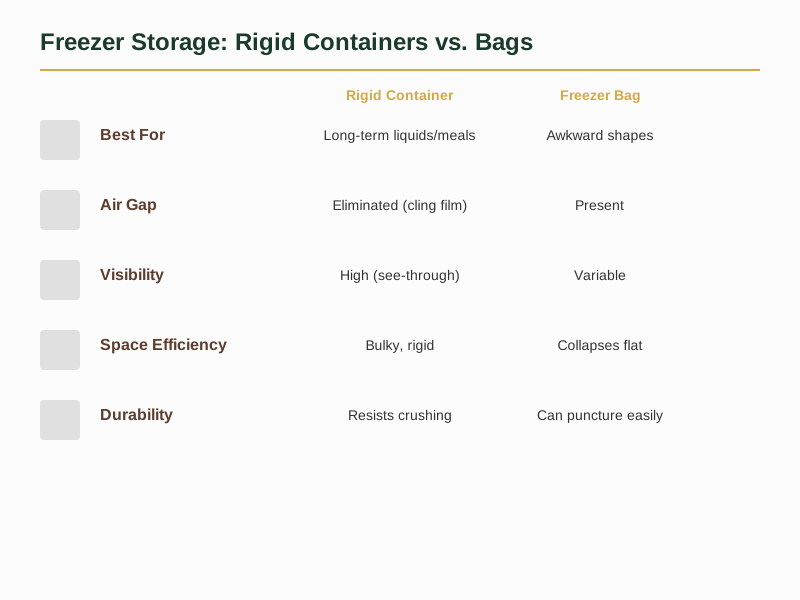
Rigid containers are best for longer storage of liquids and meals, where they can reduce the air gap with close-fitting covering, while freezer bags are better suited for shorter storage and awkward shapes, where their ability to collapse flat offers superior space efficiency despite the presence of an air gap between the food and the bag wall. Containers offer high visibility of contents without opening and resist crushing, whereas bags can be more susceptible to puncturing.
Practical Packaging Choices
Freezer packaging involves material trade-offs: rigid containers protect liquids and saucy dishes best, bags suit flat dry items, while wraps work mainly as a secondary layer. The goal is minimising air exposure rather than seeking absolute elimination.
For quality preservation with important dishes, a rigid container with cling film pressed onto the surface represents one practical approach for reducing air exposure. For everyday short-term storage, a quality freezer bag with air pressed out serves adequately at lower cost.
Specialist equipment like vacuum sealers isn’t essential for most households. The key lies in proper technique: pressing cling film down effectively, sealing containers properly, and labelling with dates. That system delivers reliable results.
Ready to apply this systematically? The portioning checklist helps sort portions before freezing rather than dealing with solid blocks that are difficult to separate.
Download the Free Freezer Labelling and Portioning Checklist and organise your freezer effectively.
Our hub on freezer packing explains how packing choices affect thawing results and freezer burn prevention.
Sources & Further Reading
As an Amazon Associate we earn from qualifying purchases. The products linked above are ones we think are worth a look.
Note: General guidance only, verify details with a qualified professional or official source.