How to Defrost Fruit for Baking and Smoothies Without Turning Mushy
As an Amazon Associate we earn from qualifying purchases. This page contains affiliate links — if you buy through them, we earn a small commission at no extra cost to you.
Freezing ruptures fruit cell walls with ice crystals, and nothing reverses that structural damage on thawing. The goal shifts from restoration to managing the liquid release. For smoothies, this doesn’t matter; for baking, it’s everything. This guide covers both scenarios.
You’ve pulled a bag of frozen berries from the drawer, tipped them into a bowl, and an hour later you’re looking at a pool of greyish liquid with some sad, collapsed fruit floating in it. It’s not a disaster — the berries are probably still usable — but they’re not going into a bake. That soggy mess puts paid to that.
The thing most “can you freeze fruit” articles skip over is that the freezing was probably fine. The thaw is where it goes wrong. Get the thaw right and the fruit holds together well enough for a crumble topping or a tart filling. Get it wrong and you’re making sauce whether you meant to or not.
Why Frozen Fruit Turns Mushy
When fruit freezes, water inside the cells forms ice crystals. Those crystals are sharp. They puncture the cell walls from the inside, and when the fruit thaws, those walls don’t bounce back — the structure is compromised. That’s the mechanism, and it’s irreversible. You’re not going to restore a frozen strawberry to its original firmness.
📺 Watch: How to Make Soft Serve Frozen Yogurt — No Machine! Better Than …
What happens next is the liquid. Once the ice melts, it has to go somewhere. At room temperature, it melts fast — faster than the fruit can reabsorb it — so the fruit ends up sitting in a bath of its own juice. That liquid is what turns a crumble into a soggy mess and a tart filling into a watery pool. The texture isn’t just soft; it’s broken down, mushy, and often greyish.
The fix isn’t complicated, but it requires two things: slowing the thaw and getting the liquid away from the fruit. That’s it. Everything else — the fridge method, the colander, the patience — is in service of those two goals.
Defrosting for Baking: The Fridge Method
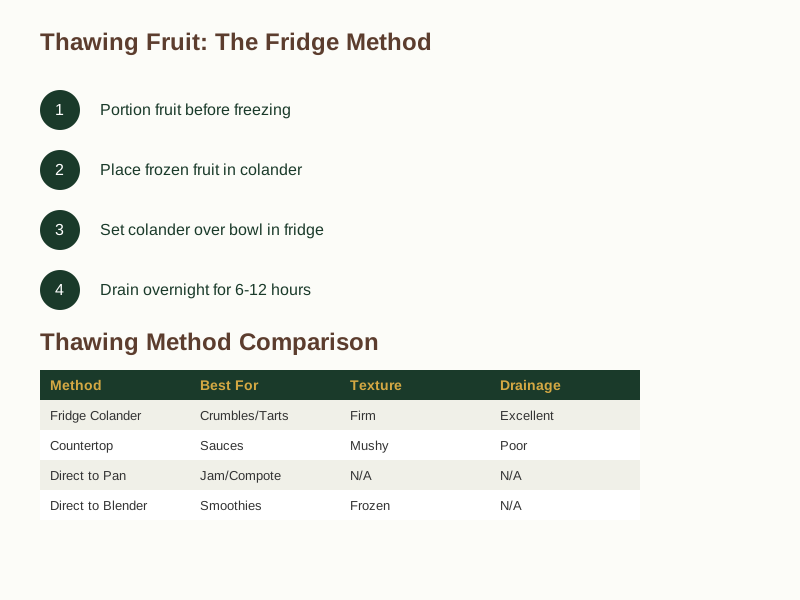
The method that actually works is the one nobody bothers with because it takes a bit of planning: overnight in the fridge, in a colander (paid link)See on Amazon set over a bowl.
Here’s the setup. Put your frozen fruit in a colander — one with gaps, not a solid bowl — and place that over a larger bowl to catch the liquid as it weeps out. Put the whole thing in the fridge. Leave it for several hours, usually overnight. By morning the fruit will be thawed but still holding its shape, and the bowl underneath will have collected a lot of liquid you can tip away.
Why does this work when the counter doesn’t? Two reasons. First, the cold fridge slows the thaw right down. Ice melts gradually instead of flooding the fruit all at once. Second, the colander means the fruit never sits in that liquid. It drains as it melts. The result is fruit that’s softer than fresh — it won’t hold up to being eaten out of hand — but firm enough to hold its shape in a crumble or a tart filling.
The counter is the mush trap. Room temperature speeds up the thaw without solving the drainage problem, so you get the same collapsed texture every time. The fridge-and-colander approach can help preserve texture for baking.
No specialist kit is needed for this. A standard kitchen colander and any bowl will do the job. If you’re batch-cooking and doing this regularly, Souper Cubes 1-cup moulds, 2-pack (paid link) are worth knowing about — they let you freeze fruit in precise portions so you’re thawing exactly what you need for a single bake rather than wrestling with a half-frozen bag. The budget alternative — a pack of silicone freezer moulds — does the same job for a fraction of the price, though you’ll sacrifice some of the neat portion control.
View Souper Cubes on Amazon → (paid link)
So, this method takes patience. If you’re baking tomorrow, you need to think about it tonight. For most home cooks with a weekly bake in mind, that’s perfectly manageable. For last-minute plans, there are other routes worth knowing about.
When Thawing Isn’t Necessary
Sometimes thawing is the wrong move entirely. If the end result doesn’t depend on the fruit holding its shape, you’re making more work for yourself and risking the texture you were trying to protect.
Smoothies are the obvious example. Frozen fruit goes straight into the blender (paid link)See on Amazon, no defrosting needed. The ice is an asset — it keeps the smoothie cold and thick rather than watery. You’re using the frozen state as a feature, not a problem to solve. Most people who make smoothies regularly have worked this out, but it bears stating plainly because the instinct to thaw “just in case” is strong.
Jam and compotes are another case where thawing is unnecessary. You can tip frozen fruit straight into the pan and cook it down by weight. The cooking process is going to break down the fruit’s structure anyway — you’re reducing it to a spread or a sauce — so the cell wall damage from freezing is irrelevant. It’s a straightforward way to use fruit you froze in season.
Crumbles and pies are where it gets more interesting. You can bake with frozen fruit without thawing it first. The fruit cooks down into the filling as it bakes, and for a crumble or a deep-filled pie where you want that soft, yielding texture, this works well. Some people actually prefer it — the fruit doesn’t release as much liquid during the initial bake, so there’s less chance of a soggy base. For a crumble or a sponge pudding, frozen fruit is perfectly sound.
For a tart where you want distinct, intact pieces of fruit visible in the filling, frozen won’t do — the cell damage is too obvious. That’s a job for fresh. But for most everyday bakes, frozen is perfectly adequate if you handle the thaw properly.
Helpful Equipment
The colander method works with what you’ve got, but a few things make it easier and more reliable.
Freezer bags are the foundation of good frozen fruit storage. A pack of basic freezer bags works fine for light use — just don’t expect the seal to hold up to repeated opening and closing. For something more durable, a thicker reusable option may be worth the investment.
Labels are the thing most people skip and then regret. A bag of “something red” is not a useful piece of inventory. A pen and a packet of freezer-rated labels (paid link)See on Amazon costs almost nothing and saves more food than any gadget in this list.
For portioning, Souper Cubes 1-cup moulds, 2-pack (paid link) are the premium option: rigid silicone trays with clear portion lines, stackable, and dishwasher-safe. They give tidy storage and remove the “how much is this?” guesswork. They’re pricey, and the lids fit snugly but are not described by the manufacturer as airtight — you’ll want cling film or a separate container lid if you’re stacking them in the freezer. But for regular batch cooks, the portion control genuinely pays for itself in reduced waste. The budget alternative — a three-pack of basic silicone moulds — does the core job for much less. They’re floppier when full and the lids fit less precisely, but for everyday portioning they’re more than adequate.
A vacuum sealer is not needed for fruit. It does remove air, which slows freezer burn, but fruit is less prone to freezer burn than many dry foods. The FoodSaver VS0290 (paid link) is an option if you want one anyway for other jobs, but it’s unnecessary spend on fruit alone.
Check FoodSaver VS0290 price → (paid link)
Common Questions About Thawing Fruit
📺 Watch: Homemade Fruit Leather Recipe (3 Ingredients, No …
Can I use the microwave to defrost fruit?
You can, but only if the fruit is destined for a sauce or a compote where texture doesn’t matter. Use short intervals and check frequently. The problem is uneven heating: some pieces will cook while others are still icy, and the result tends towards mush. It’s a last resort, not a method to reach for routinely.
Can I refreeze thawed fruit?
Once thawed, the texture will be significantly degraded — the cell walls are already broken, and a second freeze compounds the damage. If you’ve thawed more than you need, use it in a smoothie or cook it down rather than putting it back in the drawer. The Food Standards Agency provides guidance on the safety of refreezing food.
Does freezing change the taste?
You may notice a slight dulling of freshness — the bright, just-picked flavour fades a little over time in the freezer. For cooked applications like crumbles, pies, and jams, this is barely noticeable. For eating fresh or using as a garnish, it’s more apparent. Frozen fruit is excellent for baking; it’s not a substitute for fresh on a summer pudding.
Final Guidance by Use Case
The colander-in-the-fridge method is the one reliable way to defrost fruit for baking without it turning to mush. It takes a bit of planning — you need to think ahead to the night before — but the result is worth it: fruit that holds its shape, a filling that isn’t watery, a crumble that actually has a crunch.
For smoothies and cooking, skip the thaw altogether and use frozen fruit directly. The other thing worth doing is portioning before you freeze. A bag of loose frozen berries is harder to manage than measured-out portions that go straight from freezer to colander to bake. If you want a simple system for getting this right — the labelling, the portions, the dates — we’ve put together a free checklist that walks through it.
Download the Free Freezer Labelling and Portioning Checklist to sort your freezer out properly.
If you’re defrosting more than just fruit today, our broader thawing guide covers everything from cooked dishes to baked goods: Getting Food Out of the Freezer in Good Shape: Thawing, Freezer Burn and Packing .
Still deciding what to freeze? Can You Freeze Fruit? Bananas, Berries and Avocado covers which fruit is worth it.
Sources & Further Reading
As an Amazon Associate we earn from qualifying purchases. The products linked above are ones we think are worth a look.
Note: This is general guidance only, verify details with a qualified professional or official source.