Can You Freeze Eggs? What Changes and How to Use Them After Thawing
As an Amazon Associate we earn from qualifying purchases. Some links on this page are affiliate links, which means we may earn a small commission if you make a purchase.
Egg contents expand when frozen, enough to crack shells and mix yolk with white. Every egg-freezing method begins with cracking. The yolk’s proteins and fats begin thickening below freezing, altering texture permanently. Understanding this physical change helps explain why some freezing methods succeed where others fail.
You can freeze eggs successfully, but the approach determines whether you get a usable ingredient or a disappointing texture. The key lies in preparing them correctly before they hit the cold.
The Honest Verdict
The Food Standards Agency advises against freezing eggs in the shell due to expansion and cracking. The more significant issue is yolk texture. Without intervention, yolks thicken and gel during freezing, becoming unpourable and grainy upon thawing.
To prevent this, break the egg and beat it before freezing. Mixing yolks and whites—and adding salt or sugar when appropriate—helps maintain a smoother consistency. There are three practical approaches:
- Beat whole eggs together — the most versatile method for everyday cooking. Crack, whisk, portion, freeze.
- Freeze whites separately — useful for baking. Thawed whites can generally be used for whipping and baking.
- Freeze yolks separately — workable with preparation. Adding salt or sugar helps reduce graininess and gelation during freezing; use them in dishes where texture changes matter less.
For most households with surplus eggs, beating whole eggs together is the most practical choice. It uses the entire egg, suits a wide range of cooked dishes, and avoids waste.
If you frequently bake and have leftover yolks from custard or icing, freezing whites separately becomes particularly valuable.
The Three Ways to Freeze Eggs
📺 Watch: 5 Ways to Freeze Eggs
Option 1: Whole Beaten Eggs
Crack each egg into a bowl and whisk until fully combined—aim for an even yellow liquid with no streaks. Pour into a freezer bag or rigid container, leaving about a centimetre of headspace for expansion. Label with the date and number of eggs.
The beating step is crucial. When yolks and whites are mixed before freezing, the emulsion stabilises, reducing the yolk’s tendency to form a firm gel. Ice cube trays offer a neat portioning method: beat the eggs first, pour into cavities, freeze solid, then transfer cubes to a labelled bag. This makes recipe measurements straightforward.
Option 2: Egg Whites Only
Separate each egg carefully, ensuring no yolk contaminates the whites. Pour into a bag or container, seal, label, freeze.
Frozen egg whites are particularly handy for baking applications where separated whites are needed. Small containers or silicone moulds work well for single-portion storage.
Option 3: Egg Yolks Only
Separate the yolks and place them in containers. Yolks alone tend to thicken during freezing due to changes in fat and protein interactions. To mitigate this, the National Center for Home Food Preservation recommends adding ½ teaspoon of salt or 1½ tablespoons of sugar per cup of yolks before freezing. Salt suits savoury dishes; sugar works for sweet recipes.
Use thawed yolks in custards, enriched doughs, or pasta sauces where a thicker consistency is acceptable. Avoid recipes requiring a pourable, emulsified yolk like hollandaise.
Never freeze eggs in their shells. The FSA advises against it, shells crack, and the egg becomes unusable.
Texture Changes After Thawing
Freezing disrupts egg structure. Upon thawing, whites may be less fluid, and yolks often remain thicker, even with additives. Flavour typically stays the same, but moisture behaviour changes.
Thawed eggs work well as a cooking ingredient rather than a fresh substitute. They’re suitable for:
- Scrambled eggs
- Omelettes and frittatas
- Quiche and savoury tarts
- Pancakes and baking
They are less ideal for:
- Poaching or sunny-side-up frying
- Recipes requiring raw, pourable yolks
- Delicate emulsions like mayonnaise
For most home cooks, the practical uses cover plenty of everyday meals.
Choosing Containers and Tools
A reliable freezer bag or airtight container is essential. Proper sealing prevents freezer burn and flavour transfer.
For whole beaten eggs, consider Lakeland Zip-Seal bags, 18×20 cm, pack of 24 . Basic freezer bags suffice for occasional use but may seal less reliably over time.
A rigid box keeps a portion of beaten egg from getting crushed. The IKEA 365+ 750 ml box (paid link) is one square container. The Sistema Klip It Plus 1 L, pack of 3 (paid link) is three 1 litre clip-lid boxes.
Buy Sistema Klip It on Amazon → (paid link)
Labelling is non-negotiable. Freezer-specific labels are designed to adhere in cold conditions, preventing mystery containers.
See Freezer Labels on Amazon → (paid link)
Need a system? Download the Free Freezer Labelling and Portioning Checklist to track your frozen items.
Thawing Eggs
Thaw eggs in the refrigerator on a plate to catch potential leaks. Allow several hours or overnight. Use thawed eggs promptly.
📺 Watch: How to Freeze Eggs | How to Thaw & Cook
For quicker thawing, use a microwave’s defrost setting only if cooking immediately afterward—edges may begin to cook while the centre remains frozen.
Refreezing thawed eggs is not recommended, as repeated freezing worsens texture deterioration. For anything safety-related, follow the Food Standards Agency guidance.
Frequently Asked Questions
Can you freeze hard-boiled eggs?
No. Freezing causes rubbery texture and significant quality loss as water expansion breaks down cellular structure. The result is unpalatable.
Can you freeze eggs in an ice cube tray?
Yes. Beat eggs first, pour into cavities, freeze solid, then transfer cubes to a bag. This provides convenient portion control for recipes.
How long do frozen eggs last?
For best quality, use within a few months. Texture changes become more pronounced over time. Always label with the freezing date.
Final Considerations
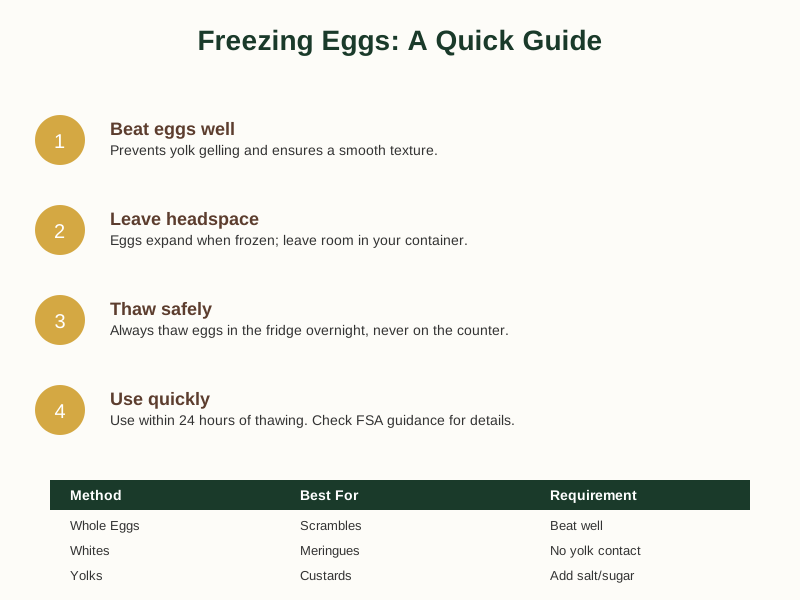
Beating whole eggs before freezing suits most home cooks. It’s straightforward, uses the whole egg, and produces a versatile ingredient for cooked dishes. If you bake regularly, freezing whites separately provides a handy supply.
Remember to beat thoroughly, leave headspace, label clearly, thaw in the fridge, and use promptly.
To maintain organisation, Download the Free Freezer Labelling and Portioning Checklist . It helps track contents and dates, reducing food waste.
Important limitation: Thawed eggs should be used in fully cooked dishes, not in soft-boiled, poached, or lightly cooked preparations. For other protein-rich foods with similar use restrictions, see our dairy hub.
Related Guides
For a complete overview, see our Freezing Dairy, Eggs and Baking: What Survives, What Changes and What to Use It For .
Sources & Further Reading
- Food Standards Agency
- USDA Food Safety and Inspection Service
- FDA Food Code
- American Egg Board
- University of Nebraska-Lincoln Food
- National Center for Home Food Preservation
- NHS Live Well
- Penn State Extension
As an Amazon Associate we earn from qualifying purchases. The products linked above are ones we think are worth a look.
Note: General guidance only, verify details with a qualified professional or official source.