Can You Freeze Mushrooms? Raw or Cooked – Texture and Best Uses
As an Amazon Associate we earn from qualifying purchases. This page contains affiliate links — if you buy through them, we earn a small commission at no extra cost to you.
Mushrooms are approximately 92% water by weight, which is why raw freezing almost always fails. The ice crystals that form from that water shred the cell structure, leaving a waterlogged mass on thawing.
You’ve probably tipped a punnet of mushrooms straight into a freezer bag, thinking you’ll deal with them later. A few weeks on, you defrost them and find something that looks more like a grey, slimy puddle than anything you’d want to eat. This experience puts most people off freezing mushrooms entirely—and it’s the reason most people are doing it wrong.
The straightforward fix is cooking them first. Frozen mushrooms then become genuinely useful meal shortcuts instead of wasted ingredients. Here’s how to do it properly.
Why raw freezing doesn’t work well
Mushrooms have a high water content, held in a structure similar to a wet sponge. Freezing can damage their structure, so raw mushrooms often thaw softer and more watery. The trapped water drains out, leaving something soft, grey, and distinctly unappealing.
📺 Watch: Freezing Mushrooms
BBC Good Food recommends sautéing or steam-blanching mushrooms before freezing for better quality, although raw freezing is possible. The mechanism is simple: heat changes the mushroom’s protein structure and drives off excess moisture before freezing. The difference in texture after thawing is substantial; a cooked mushroom that was pan-fried until golden will hold its shape reasonably well in a sauce, whereas a raw mushroom defrosted in the same conditions will have turned to something you’d strain out rather than serve.
This makes freezing raw mushrooms mainly suitable for blending into soups or sauces where texture doesn’t matter. For anything requiring bite or visual appeal, it’s the wrong approach.
The cook-first method: how to do it right
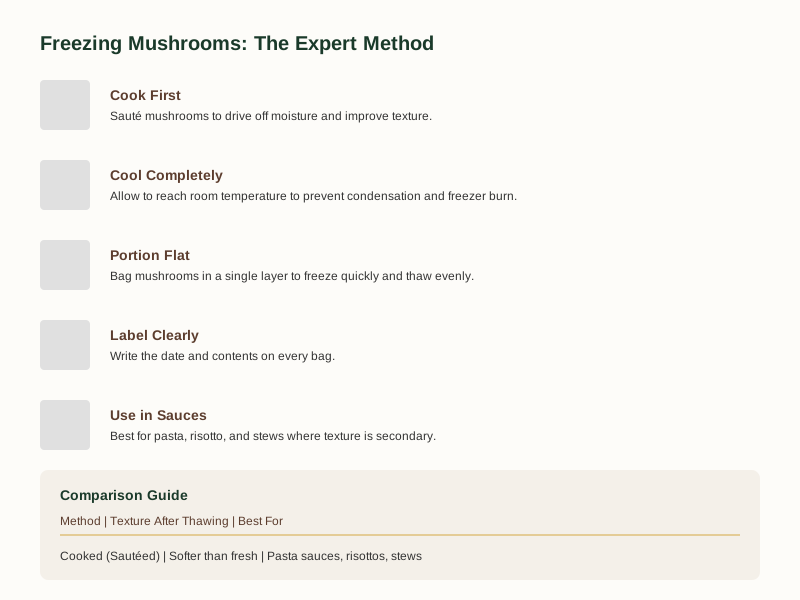
Getting this right is straightforward. The steps are sauté, cool, portion, label.
Sauté — A quick blast in a hot pan with a little butter or oil does the job. You’re not cooking them fully; you’re driving off surface moisture and getting some colour, which means flavour. Sauté for about 2–4 minutes, stirring often. You can also steam-blanch them, which works well if you want to keep the oven or hob free. Either way, the goal is to get them from raw to partially cooked with much less water in them.
Cool — This matters more than people realise. Cool them completely before bagging to reduce condensation and help maintain quality. Spread them on a plate or tray, let them cool right down, and then bag them.
Portion — Flat bags work better than tubs here. Lay the mushrooms in a single layer or thin stack inside a freezer bag, then flatten the bag as you seal it. This means they freeze quickly and thaw evenly. For recipes like risottos or pasta sauces, portioning them in handful-sized amounts makes weeknight cooking much easier; you grab a bag, tip it straight into the pan, and dinner’s half sorted.
Label — Date and contents. It’s obvious, but it’s the step that separates useful frozen ingredients from mystery bags at the back of the freezer that eventually get binned.
Now you’ve got a system. Download the Free Freezer Labelling and Portioning Checklist —it’s a simple reference for getting this right every time, without overthinking it.
Best uses for frozen mushrooms
Cooked, frozen mushrooms are usually softer than fresh ones that went straight into a pan. They’re not going to look like a restaurant garnish, and they won’t have the same satisfying bite as a mushroom that never saw the inside of a freezer.
📺 Watch: How to Freeze Mushrooms
What they’re good for is anything where texture is secondary to flavour. A pasta sauce with cream and garlic—the mushrooms are there for their earthy, umami depth, not as a textural feature. Risotto works well because the rice does the heavy lifting and the mushrooms fold in softened. Stews and casseroles are ideal: a long cook in liquid masks any softness. Omelettes and frittatas are another natural fit; the egg holds everything together and the mushrooms contribute flavour without needing to stand out.
Avoid situations where you’d want a firm, fresh mushroom: a salad, a garnish, or a burger topping where you want something that holds its shape and has a bit of chew. For those uses, buy fresh and use them while they’re fresh.
Equipment that helps
You don’t need much kit for this, but the right bags make a difference. Good quality zip-seal freezer bags work well for portioning cooked mushrooms. For cooked mushrooms, a solid tub is worth having too. The Joseph Joseph Nest Lock 5-piece lunch set (paid link) containers offer space-saving nesting with clip-down lids. If you want the core function without the premium, the Lock & Lock HPL825 2.3 L, pack of 2 (paid link) provides a leak-resistant alternative for everyday use.
See Joseph Joseph Nest Lock on Amazon → (paid link)
Skip vacuum sealing for mushrooms—it may compress them and alter their texture. A good zip-seal bag with the air pressed out does the job without the extra step.
Mushroom freezing methods
| Method | Texture After Thawing | Best For |
|---|---|---|
| Raw | Soft, grey, watery | Blending into soups and sauces |
| Cooked (Sautéed) | Softer than fresh | Pasta sauces, risottos, stews |
| Cooked (Steamed) | Softer than fresh | Casseroles and long-cooked dishes |
| Zip-Seal Bag | Retains some shape | General meal shortcuts |
Cooked mushrooms are usually softer than fresh ones. Choose a method based on the texture you need in your final dish.
Final thoughts
Don’t freeze mushrooms raw unless you genuinely don’t care what they feel like on the plate. Cook them first—a quick sauté takes about 2–4 minutes, and you can do a whole punnet at once—and you’ve got a genuinely useful frozen ingredient that works in most of the meals you already cook.
The effort is low, the waste reduction is real, and the result is something you’ll actually reach for. Get the labelling and portioning sorted and it’ll become a habit worth keeping.
Grab our free Freezer Labelling and Portioning Checklist to make sure every bag you freeze is properly marked and ready to use.
Frozen mushrooms genuinely perform well in risotto, stroganoff, and pie filling—dishes where their texture blends seamlessly. To see where mushrooms sit alongside other high-water vegetables in the full freezing guide, visit our Freezing Vegetables, Fruit and Herbs hub .
Sources & Further Reading
As an Amazon Associate we earn from qualifying purchases. The products linked above are ones we think are worth a look.
Note: General guidance only, verify details with a qualified professional or official source.