How to Freeze Onions: Chopped, Whole or Caramelised – Texture Changes
As an Amazon Associate we earn from qualifying purchases. This page contains affiliate links — if you buy through them, we earn a small commission at no extra cost to you.
Raw chopped onions can go straight into the freezer without blanching, unlike almost every other vegetable. This works because their intended use is always cooked, making the texture loss from freezing irrelevant. If you’ve ever wondered how to preserve that surplus bag of onions without creating a watery mess, this is the starting point.
The practical reality is that freezing changes onions, but understanding which format holds up lets you use your freezer confidently.
Why Freezing Affects Onion Texture
Water content is the key factor here. Onions are roughly 80–90% water, held within their cellular structure.[4][7] During freezing, this water forms ice crystals that rupture the cell walls, collapsing the firmness you’d expect from a fresh onion.
📺 Watch: How to freeze onion - 2 Different ways
The format you choose makes all the difference. Chopped raw onions, frozen quickly on a tray, tend to hold up reasonably well for cooking. Since the cells are already cut, the structural damage is less dramatic. They won’t work raw in a salad, but added directly to cooked dishes like curries or stews, they perform adequately.
Whole onions, however, become a soft, slippery mess after thawing. The large intact cells rupture uniformly, destroying their structural integrity. It’s generally not worth the freezer space.
Caramelised onions are the real success story. The cooking process has already broken down cell walls and driven off moisture, so freezing has minimal additional impact. They typically retain good flavour and freeze beautifully in portion-sized batches, making them a practical shortcut for pizzas, tarts, and sauces.
Practical Freezing Methods
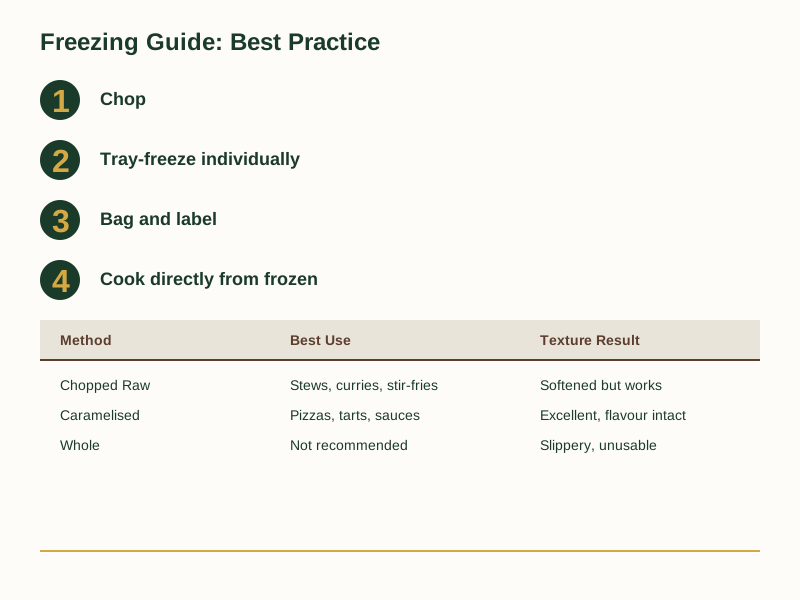
Chopped raw onions are the most versatile option for cooking. Dice or slice them to your preferred size, spread in a single layer on a tray, and freeze until solid (about an hour). Then transfer to a freezer bag, press out the air, and label. This prevents clumping and makes them easy to use later. A roll of 1,000 freezer labels, 1×2 in (paid link) is a simple tool that brings order to any freezer.
View Freezer Labels on Amazon → (paid link)
Caramelised onions are ideal for batch cooking. Slice onions thinly and cook slowly until golden and soft. After cooling completely, portion into freezer bags or containers. Ice cube trays offer great flexibility. They’ll keep well for up to 3 months according to Love Food Hate Waste, with the flavour generally well preserved.[1]
Whole onions aren’t recommended. They occupy significant space and thaw into a state that’s difficult to use effectively. Chopping before freezing is always the better approach.
Air removal is crucial. Freezer bags work well for both chopped and caramelised onions—pressing out air before sealing helps prevent freezer burn. If using containers, select sizes that minimise headspace. Lakeland Zip-Seal bags, 18×20 cm, pack of 24 are a good option due to their thickness and reliable seal. Always label with the date. It’s also worth noting that onions generally do not need blanching before freezing. While blanching helps preserve colour and flavour in some vegetables by deactivating enzymes, it provides no significant benefit for onions given the inherent texture changes from freezing.[4][7]
When selecting containers, it’s best to avoid glass jars as they can crack as contents expand during freezing, creating a preventable hazard.[2] Freezer-safe plastic bags or rigid containers are safer and more space-efficient. Transfer caramelised onions from a fridge jar to a suitable container before freezing.
For the best flavour, use frozen onions within a few months, as flavour intensity can diminish over time.[1] Always label with the date for reference.
Using Frozen Onions
The easiest method is cooking frozen chopped onions directly. Add them to a hot pan with oil—they’ll thaw and soften during cooking, saving you a step. This works perfectly in dishes with longer cooking times like soups and casseroles.
📺 Watch: Here’s HOW TO FREEZE ONIONS Properly | Recipes.net
For occasions where you need thawed onions, transfer the bag to the fridge the night before. For larger quantities, allow enough time for the centre to thaw fully. Using a sealed bag on a plate handles any condensation neatly.
If you’re in a hurry, microwave defrosting is possible. Use the defrost setting and monitor closely to avoid uneven cooking at the edges.
Caramelised onions can be reheated directly in a pan over medium heat.
Onion Freezing Methods at a Glance
| Method | Best Use | Texture Result |
|---|---|---|
| Chopped Raw | Stews, curries, stir-fries | Softened but suitable for cooking |
| Caramelised | Pizzas, tarts, sauces | Good, flavour well preserved |
| Whole | Not recommended | Becomes soft and difficult to use |
Making Freezing Work for You
Adopting a “freeze for the job” mindset turns surplus onions into a useful ingredient. Chopped raw onions become a convenient cooking staple, while caramelised onions offer a flavourful shortcut. Portioning before freezing—whether in half-onion amounts or batch-sized blocks—makes them even more practical. Using a labelling system prevents future guesswork.
For a handy tool to organise your freezer, download the Free Freezer Labelling and Portioning Checklist .
Further Reading
Our hub on freezing vegetables, fruit and herbs shows where onions sit alongside other aromatics and vegetables in the complete freezing guide.
Sources
- Love Food Hate Waste
- Food Standards Agency
- University of Nebraska-Lincoln Food Source Information
- Penn State Extension
- National Center for Home Food Preservation
- BBC Good Food
- ScienceDirect - Food Structure Journal
As an Amazon Associate we earn from qualifying purchases. The products linked above are ones we think are worth a look.
Note: This is general guidance only; verify details with a qualified professional or official source.