Can You Freeze Tomatoes? Whole, Chopped or Sauce – Best Uses
Yes, you can freeze tomatoes — but the one fact that changes how you use them is this: freezing ruptures the cell walls, so thawed tomatoes are always soft and suitable only for cooked applications. They’ll never recover their fresh texture for salads or slicing.
Ice crystals form inside the tomato as it freezes, breaking down the cellular structure. When it thaws, the flesh becomes soft and watery — perfect for a pot of sauce that simmers for an hour, but useless for a salad where you want something that holds its shape. The key decision isn’t whether to freeze; it’s which method suits how you’ll actually cook with them later.
This is where most guides stop. I’ll explain the three methods, what each one is best for, and the one packing mistake that ruins more frozen tomatoes than anything else.
Freezing Methods Compared
Three approaches serve different cooking needs.
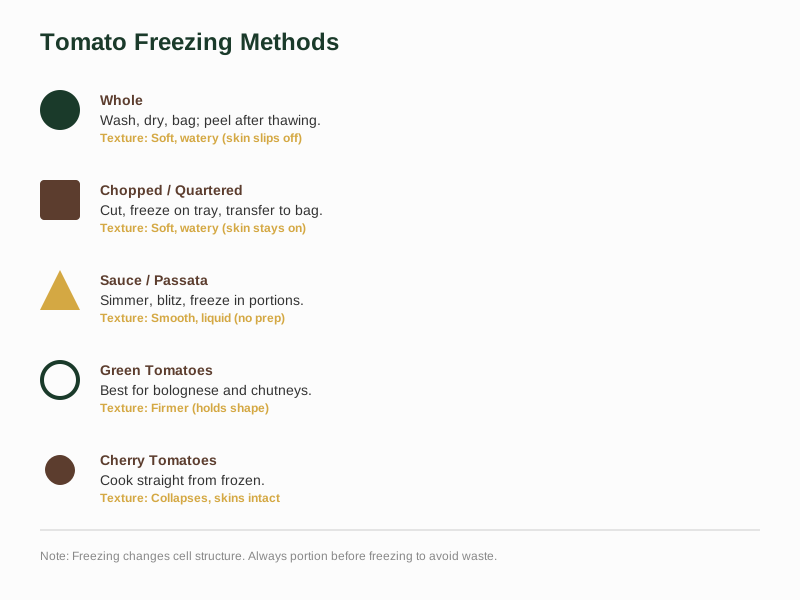
Freeze them whole. Wash, dry, and pop them straight into a freezer bag — no peeling, no chopping. The skin often splits as the water inside expands, and when they thaw, the skin may loosen. That’s the real win here: freezing whole sidesteps the blanching-and-peeling palaver entirely. Larger tomatoes take up more space in the bag, so for a big glut this matters, but for a handful it’s barely worth thinking about.
Cherry tomatoes are particularly forgiving — you can often cook them straight from frozen without thawing first. Drop them into a simmering pan and they’ll collapse in minutes, skins and all, ready for a pasta sauce or a quick soup. This is the easiest method if you want maximum simplicity and minimum waste.
Freeze them chopped or quartered. Cut out the core, split them into quarters or chunks, and freeze on a tray first so they don’t clump together, then transfer to a bag once solid. The trade-off is that you lose the skin-slip benefit — the skin stays on, which means it ends up in your sauce unless you skin the tomatoes before freezing. For many cooked dishes this genuinely doesn’t matter. Quartering also fits more into the freezer and portions out more easily, which is the practical reason most people prefer this method for regular use.
Cook them down into sauce or passata first. This method requires the most effort upfront but gives you the most convenience later. Simmer the tomatoes until they collapse, blitz if you want a smooth passata, cool completely, and freeze in portions. You lose flexibility — you can’t easily turn a pre-made passata into stuffed tomatoes — but you gain a product that’s ready to use directly from the bag with no further prep.
Which should you choose? If you cook sauces regularly, the whole or chopped methods win because they keep options open. If you batch-cook soups or bolognese, the pre-made passata approach saves significant time across multiple meals.
Prep and Packing
Good freezing starts before the bag. Wash and dry tomatoes thoroughly — any surface moisture becomes ice, which degrades texture and causes the pale, papery patches known as freezer burn. Pat them dry with a clean tea towel and don’t skip this step.
For sauce or passata, use rigid containers — they prevent leaks, stack neatly, and protect the liquid from crushing. For whole or chopped tomatoes, freezer bags work fine, and the squeezing-out-of-air trick matters more than the bag itself. Lay bags flat to freeze, then stack them; this saves a surprising amount of space in an under-counter freezer.
Leave headspace for expansion. Tomato sauce especially expands as it freezes, and a full rigid container can crack or push its lid off. A centimetre or two at the top is enough.
On how long they’ll last: tomatoes are best used within a few months for quality. Keep your freezer at -18°C or below and use airtight packaging.
Lakeland Zip-Seal bags, 18×20 cm, pack of 24 are worth knowing about if you freeze a lot. They’re thicker than basic supermarket bags, the zip seal closes without a clip, and they can be reused if you wash them out. The cost is a bit more than budget options, so it’s worth checking the seal each time. If you’re buying in bulk or doing weekly batch cooks, a sturdier bag may mean fewer burst bags.
Thawing and Cooking
When it comes to thawing, a few approaches work. The slowest and gentlest method is the fridge overnight — move your bag or container from the freezer to the fridge the night before and it’s ready when you need it. Faster options include submerging the sealed bag in cold water, or using the microwave’s defrost setting if you’re cooking immediately afterwards.
One thing worth noting: you can often skip thawing whole frozen tomatoes entirely for cooked dishes. Drop them straight into a simmering pan from frozen — they’ll collapse in minutes, the skins loosen and can be fished out or left in, and the whole job is faster than thawing first.
The liquid that collects as the tomatoes defrost can be added to whatever you’re cooking.
For sauces, stews, soups, and curries, frozen tomatoes perform well. The texture is soft and broken-down, which is exactly what you want when something simmers for an hour anyway. For dishes where the tomato needs to hold its shape — bruschetta, gazpacho, a fresh salad — use fresh tomatoes instead. Frozen ones won’t recover their firmness.
Green tomatoes freeze fine too. They work well in cooked dishes like bolognese or chutney, but are a better option than trying to use them raw. Blanching tomatoes before freezing is only necessary if you want to remove the skin before freezing. If you freeze whole tomatoes raw, the skins often slip off easily after thawing, so blanching is optional for most people.
Freezing Methods Comparison
| Method | Best For | Prep Effort | Texture After Thawing |
|---|---|---|---|
| Whole | Simplicity, peeling after thawing | Minimal | Soft, watery, skin may loosen |
| Chopped/Quartered | Regular cooking, portioning | Moderate | Soft, watery, skin stays on |
| Sauce/Passata | Batch cooking, ready-to-use | High | Smooth, liquid, no further prep needed |
| Green Tomatoes | Bolognese, chutneys | Minimal | Works well in cooked dishes |
| Cherry Tomatoes | Quick sauces, soups | Minimal | Collapses quickly, skins intact |
Getting the Most From Frozen Tomatoes
Freezing tomatoes pays back quickly once you know what the texture changes mean for cooking. Whole tomatoes are the simplest method — wash, bag, freeze, peel after thawing. Chopped or quartered tomatoes are the prep-saver if you cook regularly. Pre-made passata costs more effort upfront but makes midweek cooking significantly faster.
📺 Watch: How to Freeze Tomatoes
The one frozen-tomato application that’s genuinely superior to fresh is slow-cooked sauce, where the broken-down cell structure accelerates the cooking. For guidance on how tomatoes fit alongside other high-water vegetables, see our freezing guide for vegetables, fruit and herbs .
Grab our free Freezer Labelling and Portioning Checklist to make sure nothing gets lost or forgotten in the depths of your freezer.
Sources & Further Reading
Note: General guidance only, verify details with a qualified professional or official source.