Freezing Dairy, Eggs and Baking: What Survives, What Changes and What to Use It For
As an Amazon Associate we earn from qualifying purchases. Some links on this page are affiliate links, which means we may earn a small commission if you make a purchase.
The block of Cheddar you will not finish, the last of the double cream, six eggs near the date, and the heel of a loaf. Almost all of it will freeze. That is the easy half of the answer, and it is the half that wastes the food if you stop there.
Freeze each of these for the job it can still do. Ice does not treat them the same way. In cheese it splits the protein network, so a slice becomes a crumble and the cheese is for the saucepan. In milk and single cream it shoves fat globules together until the emulsion breaks, so they go into cooking, not into a glass or a whisk. Double cream carries enough fat to keep an emulsion you can still whip. Eggs have to come out of the shell before any of that matters. Bread is worth freezing only while it is still fresh, and it goes soggy when you thaw it inside the bag, not because you froze a whole loaf.
That is the map. The rest of this page is why each line holds, and which of the cluster guides to open when you are holding that particular food.
Three structures, three different failures
Name the structure and the result is predictable.
Watery foods grow large ice crystals that puncture the gel holding them together. Yoghurt weeps. Soft cheese puddles. Baked puff goes limp because the flakes take that water back in.
Milk and single cream are fat droplets held apart in water. Ice crowds the droplets until they clump, and you get a watery layer and a fatty one. Shaking puts milk back together for a sauce or a cup of tea. It does not put single cream back together well enough to whip. Butter is the opposite: nearly all fat, very little water, so ice has little to break. What ruins butter is air and the smell of whatever else is in the freezer.
Hard cheese is a protein matrix. Crystals shove it apart. Flavour stays. The slice does not. Egg yolks are a different gel: freeze them neat and they set gluey. Whites do not. They are the part that still whips.
Air in the bag adds a second failure. The Food Standards Agency’s guidance on chilling, freezing and defrosting describes freezer burn as cold, dry air drying the surface until ice crystals form. That is quality, not safety. The same page says a domestic freezer should sit around -18°C. How long to keep something, and how soon to eat it once thawed, is on that page and on the pack. This site does not invent a storage time.
Cheese is a cooking cheese now
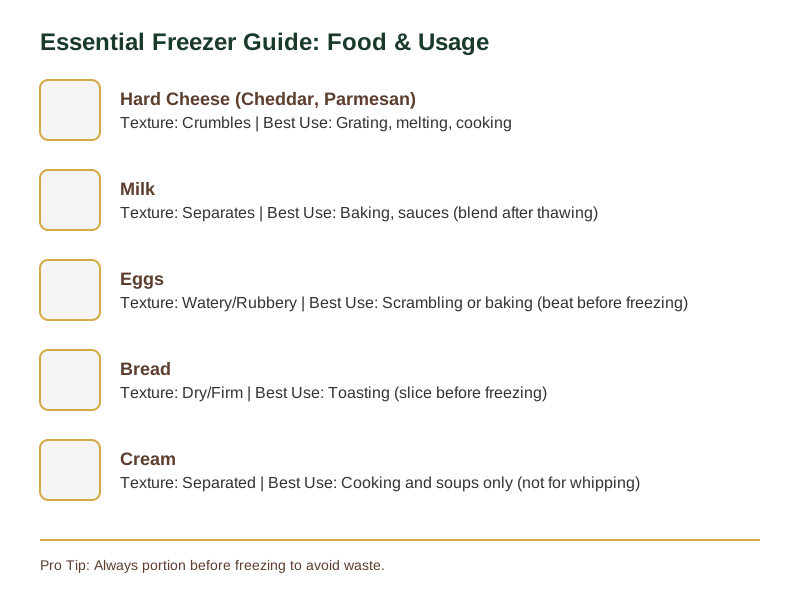
Grate Cheddar, Red Leicester, Gouda, Parmesan and the other hard cheeses before they go in. A whole block thaws unevenly. Grated cheese goes from the bag into a white sauce, a cauliflower cheese or a pizza. It will not slice for a board. Flavour survives. The cut edge does not. Arla Pro’s freezing guide says the same of cheddar: freeze pieces, slices or grated cheese, thaw in the fridge, cook with it. Mozzarella, on that guide, weeps and browns more than fresh. Thaw it fully and melt it. Do not put it in a salad.
📺 Watch: How to Freeze Cheese - 3 Easy Ways to Make It Last!
Brie and Camembert earn a place only if you will melt them completely. The rind splits and the inside weeps. Stilton belongs with those moisture-rich cheeses, not with the Cheddar. Feta comes back as crumbs, which suits a hot dish and not a neat cube. Cream cheese goes grainy and leaks. Cheesecake batter and cooked sauces, yes. Spreading, no. Low-fat versions have more water and fare worse. Eat those fresh.
A block that is already thawed is still a cooking cheese. Sauces and gratins are in uses for thawed cheese . Types are in which cheeses freeze .
Milk, cream and yoghurt: the fat decides the job
Shake thawed milk hard and use it in sauces, baking and tea. It is a poor glass of cold milk. Leave headroom. A standard glass bottle cracks unless the glass is rated for the freezer, because the liquid expands. Cartons split more readily than plastic, so bag them. Oat, almond and soy go grainy, and shaking does not give you a smooth drink. Those are for cooking. Detail is in why frozen milk separates .
Cream is not one ingredient. Single cream separates and will not whip. Put it in a soup, a curry or a sauce. Double cream still whips after thawing, with peaks less proud than a fresh carton. Whipping cream sits between them: cook with it, and whisk only if it is holding. Clotted cream splits and goes grainy. That is for today’s scones, not the freezer. Arla sends all fresh cream into blended soups and sauces. Follow the fat split, and read double, single and whipping cream for the carton you have.
Yoghurt comes back as whey and grainy curds. Do not eat it from the tub. Smoothies, batters and marinades are the job. Greek yoghurt has less loose water, fares best, and is still not a breakfast pot. Arla’s line matches: grainy and watery, useful as the base of a frozen dessert, not as yoghurt. Uses are in what to do with frozen yoghurt .
Butter is the one that barely changes
Bag butter so air cannot reach it. The paper wrapper is not enough. Fat holds the smell of whatever else is in the freezer, and that is the failure, not a collapse of texture. A freezer bag with the air pressed out is enough. A vacuum sealer is the long way round.
Grate it from frozen into pastry, scones and crumble. Cold fat is what those doughs want. For spreading, thaw in the fridge. On the counter the outside softens while the middle is solid, and the butter goes grainy. Salted is the block to leave if you are unsure when you will use it. Unsalted is for baking, and it wants using sooner. If you melt a block by mistake, cook with it. Do not freeze it again. Wrapping and grating are in what happens to frozen butter .
Eggs: out of the shell, then into a cooked dish
Never freeze an egg in its shell. The contents expand and the shell cracks. British Lion’s egginfo page says crack them, freeze only in-date eggs, and leave a little room for expansion.
📺 Watch: How to Perfectly Freeze Eggs! | Nellie’s Free Range
Beat whole eggs together. That is the default when you simply have too many. Label how many went in. Whites freeze as they are and still whip for baking. Yolks gel if you freeze them neat. Stir in salt or sugar first, label which, and take the quantity from that egginfo page rather than a guess.
Thaw in the fridge. Egginfo’s rule is thoroughly cooked dishes only, never from frozen. That rules out soft-boiled and poached. How long they are worth keeping is on that page. The three methods are in freezing eggs and using them after thawing .
Bread, cake, pastry and dough
Freeze bread the day it is baked or bought. Freezing pauses staling. It does not rescue a loaf that is already stale. Slice a supermarket loaf for the toaster. Freeze a crusty loaf whole if the crust is the point. The soggy result blamed on a whole loaf is condensation: take it out of the bag before it thaws, or you steam the crust. A short spell in a moderate oven dries the surface of a whole loaf. Both routes are in how to freeze bread and how to thaw it without a soggy crust .
📺 Watch: How to Freeze Cakes | Basics | Better Homes & Gardens
A plain sponge, a fruitcake and brownies are worth the space. A fresh-cream filling is not, because the cream separates. Freeze the cake base and eat a meringue topping now. Set an iced cake uncovered until the outside is firm, then wrap, or the buttercream smears onto the cling film. Slice first so you thaw a portion. The step is in freezing sponge, fruitcake and iced cakes .
Freeze puff raw and bake it from frozen. Baked puff takes water back into the flakes and goes soggy. Shortcrust works raw or as a blind-baked case. Skip filo once the pack is open and the sheets are drying. Freeze it unopened and thaw it in the fridge. The split is in puff, shortcrust and filo .
Freeze cookie dough raw, in balls, and bake from frozen. Browning happens in the oven, so a biscuit frozen after baking loses the crisp edge. Portion on a tray until solid, then bag, or the balls weld together. The comparison is in raw dough or baked cookies .
I’d grate the hard cheese, freeze the double cream and the beaten eggs, and leave clotted cream and a Brie for the board this week. Freezing the wrong thing is a postponed bin. The table below is the same call, item by item.
Pack it so the freezer does not finish the job
Air is the extra damage. Press it out of the bag. The Lakeland Zip-Seal bags, 18×20 cm, pack of 24 (paid link) are heavy-gauge reusable zip-seal bags with a write-on strip. For occasional use, standard freezer bags provide adequate protection at lower cost.
View Lakeland Zip-Seal 18×20 cm bags on Amazon → (paid link)
Portion before you freeze. One block of grated cheese, one or two beaten eggs, a splash of cream: thaw what you will use. Label contents and date with waterproof 1,000 freezer labels, 1×2 in (paid link), which adhere better in freezer conditions than paper stickers. The Freezer Labelling and Portioning Checklist is the straightforward system for doing that the same way each time.
See Freezer Labels on Amazon → (paid link)
Defrost in the fridge. That is the Food Standards Agency’s instruction, so the food does not sit warm while the middle is still frozen. The same page is where to check how soon to use something once it has thawed, and what the Agency says about freezing food again after cooking. A freezer thermometer like the TempPro TP110 (paid link) confirms your freezer maintains the recommended -18°C temperature, particularly important for older units or those in variable environments.
Check TempPro TP110 price → (paid link)
For versatile freezing: Lakeland Zip-Seal bags, 18×20 cm, pack of 24 (paid link) offer durability and reusable functionality. The sturdy construction handles repeated use well, making them cost-effective for regular freezing.
For container storage: the Joseph Joseph Nest Lock 5-piece lunch set (paid link) is a 5-piece nesting lunch set with snap-together lids. The IKEA 365+ 750 ml box (paid link) is one cheaper 750 ml square box.
See Joseph Joseph Nest Lock on Amazon → (paid link)
For portion-controlled freezing: Souper Cubes 1-cup moulds, 2-pack (paid link) silicone trays create uniform portions that stack efficiently. The rigid design supports easy transport when filled. For occasional use, standard ice cube trays provide similar portioning at lower investment.
Check Souper Cubes price → (paid link)
For basic needs: A reliable labelling system matters more than premium equipment. Waterproof labels and a permanent marker (paid link)See on Amazon ensure you can identify frozen items months later.
Use it for this, not for that
| Food | What changes | Use it for | Leave it out when |
|---|---|---|---|
| Hard cheese | Crumbles; flavour stays | Sauces, gratins, pizza, grated from frozen | You wanted a slice or a board |
| Brie, Camembert, Stilton | Rind splits; interior weeps | A dish that melts them completely | You wanted them raw |
| Cream cheese | Grainy, liquid pools | Cheesecake batter, cooked sauces | You wanted to spread it |
| Feta | Falls to crumbs | Scattered through a hot dish | You wanted salad cubes |
| Milk | Fat clumps; shake it | Sauces, baking, tea | You wanted a cold glass |
| Single cream | Splits; will not whip | Soups, sauces, curries | You wanted peaks |
| Double cream | Still whips, less firmly | Whipping and cooking | You need fresh-carton peaks |
| Whipping cream | Between the two | Cooking; whip only if it holds | You are assuming it will peak |
| Yoghurt | Whey and grainy curds | Smoothies, baking, marinades | You wanted it from the tub |
| Butter, wrapped | Little texture change; smells if bare | Grated into pastry; spread after a fridge thaw | It is still in the paper wrapper only |
| Eggs in the shell | Shell cracks | Nothing. Crack them first | The box is still whole |
| Beaten whole eggs | Fine once cooked through | Baking, scrambling | Soft-boiled or poached |
| Egg whites | Freeze cleanly | Whipping and baking after a fridge thaw | — |
| Egg yolks, neat | Gel and go gluey | Only after salt or sugar, then cooking | You needed them pourable |
| Bread, frozen fresh | Holds; does not un-stale | Toast from frozen, or a loaf revived out of the bag | The loaf was already stale |
| Plain sponge, fruitcake, brownies | Hold | Portions | — |
| Fresh-cream cake, meringue | Cream splits; meringue softens | Eat now | The freezer |
| Iced cake | Icing smears if wrapped soft | Flash-freeze until firm, then wrap | You wrapped it while soft |
| Puff, raw | Layers hold | Bake from frozen | It is already baked |
| Shortcrust | Raw or baked both work | Cases and leftover dough | — |
| Filo, unopened | Manageable if thawed in the fridge | Use promptly | The pack is already dry |
| Raw cookie dough | Bakes properly later | Balls, straight into the oven | You froze the baked biscuits for a crisp edge |
Open the guide that matches what is in your hand:
- Can You Freeze Cheese? Which Types Work and What Happens to the Texture
- How to Freeze Bread and Get It Back Tasting Fresh
- Can You Freeze Eggs? What Changes and How to Use Them After Thawing
- Can You Freeze Milk? Why It Separates and How to Still Use It
- Can You Freeze Butter? Yes, But Here’s What Happens to the Texture
- Can You Freeze Cream? The Difference Between Double, Single and Whipping Cream
- Can You Freeze Cake? How to Freeze Sponge, Fruitcake and Iced Cakes
- Can You Freeze Pastry? Puff, Shortcrust and Filo – What Works
- Can You Freeze Cookie Dough? Freeze Raw or Baked? Which Tastes Better
- Can You Freeze Yogurt? What Happens to Texture and How to Use It
- How to Thaw Frozen Bread Without Getting Soggy
- What to Do With Thawed Cheese: Best Uses for Crumbly or Dry Cheese
Grab the Freezer Labelling and Portioning Checklist before the next shop, and label the bag while you still remember which cream it was.
Explore More Topics
Quick answers:
Sources & Further Reading
As an Amazon Associate we earn from qualifying purchases. The products linked above are ones we think are worth a look.
Note: General guidance only, verify details with a qualified professional or official source.