How to Prevent Freezer Burn and What to Do If You Already Have It
As an Amazon Associate we earn from qualifying purchases. Some links on this page are affiliate links, which means we may earn a small commission if you make a purchase.
Freezer burn—those dry, discoloured patches on frozen food—is dehydrated, oxidised tissue that has lost moisture to the surrounding air through sublimation. This is fundamentally a packaging failure, not a temperature failure. The fix always lies at the sealing stage, not the thermostat.
You open the freezer and pull out a bag of peas. There they are—those chalky white patches across the surface, the peas looking a bit dried out at the edges. You’ve seen it before on a tub of leftovers. Is this ruined?
No—but only if you know what to look for and what to do next. Freezer burn looks alarming but rarely means what you think. Most people bin the lot, and that’s money straight in the bin.
This guide covers what freezer burn actually is, how to stop it happening, and—if it’s already there—how to salvage the food without wasting it.
Understanding the Cause: Freezer Burn Explained
Freezer burn is dehydration. That’s it. It’s a quality problem rather than a sign of anything else.
📺 Watch: How to Freeze Fish and Avoid Freezer Burn
Here’s what happens: when food sits in cold, dry air, the moisture inside it gradually turns to ice crystals and sublimates—it goes straight from ice to gas without melting first. The gas escapes, and the food left behind loses water, which can affect colour, flavour and texture. You typically see it as greyish-brown or white patches on the surface, a dry or leathery texture, and sometimes ice crystals that have formed on the outside rather than inside the packaging.
It’s a straightforward sublimation process—the same thing that causes ice cubes in your freezer to shrink over time. The food has simply lost moisture in the affected areas. For any question about whether food is fit to eat, check the Food Standards Agency’s advice.
Think of it like a plant drying out in the sun—it becomes dried out. The rest of the food is usually unaffected in texture.
If you’ve spotted it on that bag of peas, don’t panic. The result is almost always salvageable.
Key Prevention Strategies
Prevention comes down to one thing: keeping air away from your food.
Air touching frozen food draws out moisture over time. Stop the air contact, and you stop the freezer burn. Here is the order of what matters most:
Cool food before freezing. For cooling and freezing cooked food, follow the Food Standards Agency guidance. Warm food creates condensation that freezes into ice crystals—and ice crystals are what sublimate.
Use airtight packaging. Freezer bags, rigid containers, or vacuum-sealed pouches—anything that creates a proper seal. Cling film on its own isn’t enough; it’s permeable to air. Pressed onto the food under a lid, it does help close the air gap. Freezer-rated bags and containers are designed to handle the cold without becoming brittle or letting moisture through.
Remove as much air as possible. With bags, squeeze out every last bit before sealing. With containers, leave appropriate headspace according to the container and food instructions. Air left inside is moisture waiting to escape.
Label and date everything. This sounds basic, but it’s the step most people skip. A freezer full of unlabelled tubs means food sitting longer than it should. The longer it sits, the more chance of freezer burn developing. A quick date written on a label costs nothing and saves food.
Keep your freezer temperature steady. Temperature fluctuations can worsen freezer burn; keep the freezer steady and avoid blocking airflow. A cheap freezer thermometer lets you check at a glance that your freezer is holding at -18°C or below. The TempPro TP110 (paid link) looks well suited to this—it provides a visual check to spot if your freezer is running warm.
Check TempPro TP110 price → (paid link)
One mistake people make is repeatedly opening large family-sized packages. Every time that air gets in, you’re losing a bit more moisture. Portion before you freeze—you’ll thank yourself when it’s lasagne night and you only need one portion, not the whole batch defrosted with half of it going back in.
Salvaging Freezer-Burned Food
It’s already there. Before you reach for the bin, here’s the call: trim off the affected areas and use the rest.
📺 Watch: Freezer Burnt Chicken: Can you eat it? What is it & Prevent it
The greyish-brown patch has lost moisture and flavour. What it has lost is texture—that dry, leathery feel won’t recover. The surrounding food is usually still good to cook with for quality purposes.
Take a sharp knife and cut away the discoloured, dried-out portion. What you’re left with is usable—you just need to cook it right.
The key is to use it in dishes where the texture loss won’t matter. Stews, sauces, soups, curries—anything with liquid. Cooking in moisture rehydrates the remaining food and masks the difference. Trimmed freezer-burned veg or leftovers simmered in a curry work well; that same dry patch in a stir-fry would be noticeable and unpleasant.
The trade-off is straightforward: don’t use it for anything where texture is the point. No crisp salads, no fried items, nothing where you’re relying on the food staying firm or juicy on its own. But in a slow-cooked dish? The salvage is genuinely good enough.
If the food smells off or looks genuinely spoiled rather than just dried, bin it and follow the Food Standards Agency’s advice. Mild freezer burn is usually a quality issue.
UK Storage Solutions
Prevention starts with the right kit. Here’s what looks worth considering, with the trade-offs to watch for.
Freezer bags
For most people, Lakeland Zip-Seal bags, 18×20 cm, pack of 24 are heavy-gauge zip-seal bags with a write-on strip. The trade-off is price, and this 18×20 cm size suits a portion rather than a bulky piece of food. If that puts it out of reach, basic freezer bags work for light use but may not withstand reuse.
Containers
The Joseph Joseph Nest Lock 5-piece lunch set (paid link) is a nesting meal-prep set, not a family of large freezer tubs. It is pricey for plastic. On a tighter budget, the IKEA 365+ 750 ml box (paid link) is one square container, useful for a single portion.
View the Nest Lock 5-piece lunch set on Amazon → (paid link)
Vacuum sealers
If you’re serious about preventing freezer burn—particularly for dry foods, baking or batch-cooked portions you freeze in bulk—a vacuum sealer is the step up worth considering. The FoodSaver VS0290 (paid link) is designed to make strong seals, and the countertop design looks straightforward to use. The catches are real: there’s a learning curve to positioning bags correctly, and the bags and running costs add up. It’s only worth it if you’d use it regularly.
View FoodSaver VS0290 on Amazon → (paid link)
A word on Souper Cubes 1-cup moulds, 2-pack (paid link)
Buy the Souper Cubes 1-cup 2-pack on Amazon → (paid link)
If batch cooking soups and stocks is part of your routine, Souper Cubes 1-cup moulds, 2-pack (paid link) can simplify portioning. The honest trade-off is price: you’re paying a premium for the convenience.
Now you know what to look for—Download the Free Freezer Labelling and Portioning Checklist to get your storage organised and start using your freezer without worry.
Common Questions Answered
Can you refreeze food after it has thawed?
Follow the FSA’s specific advice for the food and thawing method; do not give a blanket refreezing rule. Refreezing can reduce quality.
Does freezer burn ruin food?
Freezer burn is dehydration, which affects texture and flavour. For any food-safety question follow the Food Standards Agency’s advice. If the food smells off, looks slimy, or shows signs of actual spoilage—not just dryness—bin it.
How long can food stay in the freezer?
Quality declines the longer food stays frozen; for storage guidance on a specific food, check the pack and the Food Standards Agency guidance. If food looks fine but has been in there a very long time, expect the texture to have suffered.
Freezer Storage Kit Comparison
| Product | Best For | Key Feature | Price Point |
|---|---|---|---|
| Lakeland Zip-Seal Bags | General use & portions | Heavy-gauge zip seal, 18×20 cm | Premium |
| Amazon Freezer Bags | Light use | Basic functionality | Budget |
| Joseph Joseph Nest Lock 5-piece lunch set (paid link) | Meal-prep portions | 5-piece nesting lunch set | Mid-range |
| IKEA 365+ 750 ml box | One portion | One square 750 ml container | Budget |
| FoodSaver VS0290 (paid link) | Serious bulk freezing | Vacuum sealing | High-end |
| Souper Cubes 1-cup moulds, 2-pack (paid link) | Soup & stock portioning | Stackable silicone trays | Premium |
| TempPro TP110 (paid link) | Temperature monitoring | Simple visual check | Budget |
📺 Watch: Prevent Freezer Burn With These Simple Steps
Salvage Protocol and Next Steps
Here’s the triage rule for already-burned food: trim the affected area (it mostly just tastes of nothing), then use the remainder in a strongly flavoured dish where the loss of surface moisture is masked. This salvage protocol fits into the full guide to packing and thawing.
Freezer burn is one of those problems that looks worse than it is. It’s dehydration, a quality problem. Trim the dry patches, throw it in a stew or a curry, and you’ve saved food that would otherwise have gone in the bin.
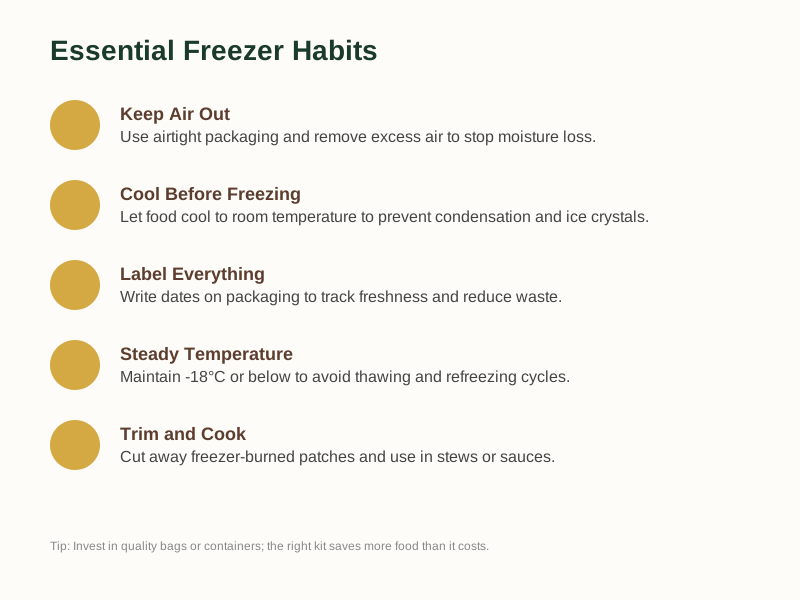
Prevention is straightforward: cool before freezing, seal out the air, date everything, and don’t let your freezer run warm. The right kit makes it easier, but the fundamentals cost almost nothing—a decent set of freezer bags and a pen for labelling does more than any vacuum sealer if the basics aren’t in place.
Stop throwing away food that’s fine. Your freezer is there to save you money, not to become a graveyard for stuff you weren’t sure about.
Grab our Free Freezer Labelling and Portioning Checklist and sort your freezer out—you’ll be surprised how much less gets wasted once you can see what’s there and when it went in.
Related Reading
For context on how freezer burn fits into the full guide to packing and thawing, see our Getting Food Out of the Freezer in Good Shape: Thawing, Freezer Burn and Packing .
Sources & Further Reading
As an Amazon Associate we earn from qualifying purchases. The products linked above are ones we think are worth a look.
Note: General guidance only, verify details with a qualified professional or official source.